How to Set Your Freelance Day Rate When You Have ADHD Tax, Sick Days and Slow Months to Cover
TL;DR. Most freelance day rate calculators are dangerously optimistic because they forget sick days, slow months, ADHD tax and the real cost of running yourself like a business.
The Calculator Everyone Uses Is Wrong
You have probably seen the standard formula. Take your desired salary, divide by 230 working days, add a bit for tax, done. Except it is not done. That number assumes you will bill every single working day, never get ill, never lose a client without warning, never have a week where your brain simply refuses to cooperate, and never spend an afternoon fixing an invoice that should have taken ten minutes but somehow ate three hours.
For neurotypical people with stable health, a predictable pipeline and a very forgiving bank account, that formula is merely optimistic. For freelancers with ADHD, chronic illness, anxiety, or any kind of variable capacity, it is a recipe for burning through savings and then wondering why the numbers never add up. The problem is not your work ethic. The problem is that the formula was not built for you.
This post is. We are going to build a freelance day rate calculator for UK self-employed people that accounts for the real texture of a working life, not the idealised spreadsheet version of it.
Soho, London. She said no, then explained exactly why. Watch on Instagram
What ADHD Tax Actually Costs You Per Year
ADHD tax is the informal term for the money, time and opportunity lost to executive dysfunction. It shows up in ways that are easy to dismiss individually but devastating in aggregate:
- Subscriptions you forgot to cancel because the cancellation process required three steps and a phone call
- Late payment fees on invoices you raised but forgot to chase
- Last-minute couriers because you missed a deadline for standard delivery
- Duplicate purchases because you could not find the thing you already bought
- Rebooking fees, missed trains, parking fines from hyperfocusing on a project and losing track of time
- Hours spent context-switching between tasks instead of finishing one thing
- Undercharging because you quoted before you properly understood the scope
A conservative estimate for someone with moderate ADHD is somewhere between £1,500 and £4,000 per year in direct financial losses, before you even count the billable hours lost to distraction or recovery. That money has to come from somewhere. It comes from your day rate, or it comes from your savings. One of those is a strategy. The other is a slow leak.
Building Your Minimum Viable Day Rate: The Honest Formula
Here is a framework that actually holds up. Work through each line and be brutal with yourself.
- Annual personal costs. Rent or mortgage, food, utilities, transport, phone, subscriptions you actually use, insurance, clothing, socialising. Do not budget for a monk. Budget for you.
- Business costs. Software, accountant fees, professional memberships, equipment replacement, home office costs, marketing, any tools you use to run your work.
- Tax and National Insurance buffer. As a UK self-employed person you owe Income Tax and Class 4 NI on profits above the threshold. A rough rule of thumb is to set aside 25 to 30 percent of everything above your personal allowance. If you are VAT registered, that is a separate pot entirely.
- ADHD tax and friction costs. Be honest. Look back at last year's bank statements and add up the waste. Then add it as a line item. If you cannot face that exercise right now, add a flat £2,000 and revisit it later.
- Sick day reserve. The average UK employee gets around 28 days of paid leave plus bank holidays. You get nothing unless you build it in. Decide how many sick and rest days you realistically need per year. Ten days is not excessive. Twenty is not shameful. Price them in.
- Slow month buffer. Freelance income is lumpy. Even good freelancers have quarters where work dries up. Build in at least eight weeks of zero income per year as a planning assumption. If you earn more than that, brilliant. If you do not, you are not surprised.
- Profit for reinvestment or savings. This is not optional. You are a business. Businesses retain profit. Add at least 10 percent on top of everything above.
Add all of that up. That is your annual revenue target. Now divide by your realistic billable days. Not 230. After sick days, slow months, admin days, CPD, pitching and general human existence, most freelancers have somewhere between 120 and 160 genuinely billable days per year. Divide your revenue target by 140 as a starting point and see what number appears. It is probably higher than you are currently charging.
"The number that makes you wince is usually the number that is correct. The number that feels safe is usually the number that is slowly making you poor."
Why Tracking Your Spending in Real Time Changes Everything
The formula above is only as good as the data you put into it. Most freelancers have a vague sense of what they spend but not a precise one, and vague sense is where ADHD tax hides. You cannot plug a number you do not know into a formula.
This is exactly where having money and tasks in one place stops being a nice-to-have and becomes genuinely useful. Browse the other posts on this blog and you will see a recurring theme: the tools that actually help busy, variable-capacity people are the ones that reduce the number of decisions you have to make, not increase them.
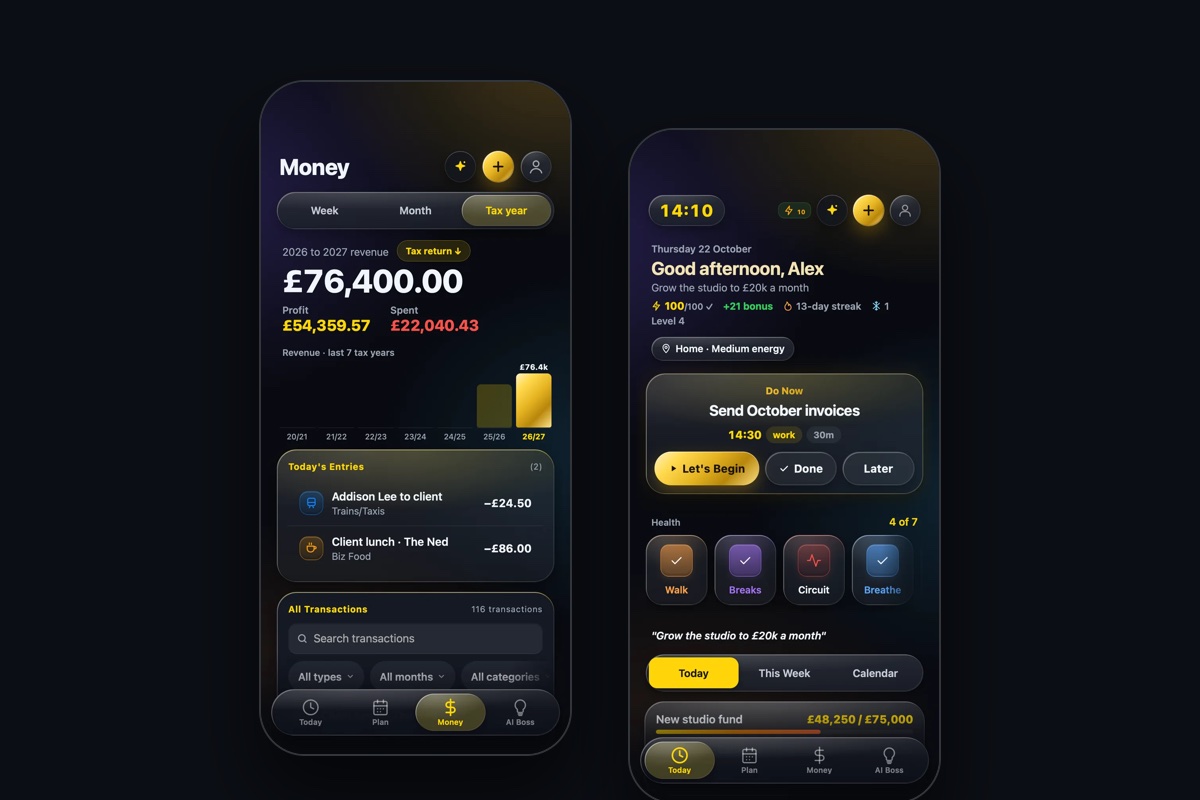
BossMode lets you log spending by voice, which sounds like a small thing until you realise that the reason most people do not log spending is that it requires opening an app, finding the right category, typing a number and remembering what the transaction was for. Voice logging collapses that to three seconds. You say what you spent and it is done. For someone whose working memory is already under pressure, that friction reduction is the difference between a system that works and one that gets abandoned by week two.
When your spending is tracked accurately, you know your real annual costs. When you know your real annual costs, you can set a day rate that actually covers them. The maths is simple. The discipline of capturing the data is where most people fall down.
The HMRC Problem Nobody Warns You About
Setting the right day rate is only half the battle. The other half is making sure that when January Self Assessment rolls around, you are not reconstructing a year's worth of expenses from memory and a shoebox of receipts.
HMRC allows self-employed people to deduct legitimate business expenses from their taxable profit. That means every piece of software, every business trip, every professional book, every relevant subscription reduces your tax bill. But only if you recorded it. Only if you can evidence it. Only if you have not lost the receipt or forgotten what the payment was for.
BossMode's Business plan is built around bookkeeping in HMRC categories. Your income and expenses are categorised as you go, not reconstructed at year end. That means your accountant spends less time on admin and more time on advice, which saves you money. It also means you are not paying tax on profit you did not actually make because you forgot to claim legitimate expenses.
This was a core part of the vision when Swain Joshua of SWAINUK LIMITED built BossMode: that self-employed people should not need three separate apps and a spreadsheet to run the financial side of their work. Money tracking, task management and health check-ins should live in one place, because that is how you actually stay on top of things when your attention is finite.
Rescheduling Without the Shame Spiral
Here is something the productivity industry does not like to admit. Some days you cannot do the thing you planned to do. Your energy is wrong, your focus is gone, something happened, or you are simply not capable of the output you scheduled. The correct response to this is to reschedule honestly, not to feel like a failure and abandon the system entirely.
Most to-do apps respond to a missed task by leaving it sitting there, red and overdue, silently judging you. That is not useful. It is demoralising. And for anyone with ADHD or anxiety, a screen full of overdue tasks is not a motivator. It is a reason to close the app and never open it again.
BossMode reschedules honestly instead of nagging. When something does not get done, it gets moved and replanned based on what is actually realistic, not what was theoretically possible on the day you made the plan. That is what a good boss does. They do not berate you for being human. They adjust the plan and tell you what to do next.
That single next action is the other thing that makes a real difference for variable-capacity freelancers. Decision fatigue is real. When you sit down to work and face a list of forty tasks with no clear priority, the temptation is to do the easy ones, or to do nothing. BossMode reads your tasks, your deadlines and your energy level and tells you the single best next action. Not a list. One thing. Do that thing. Then ask again.
How to Raise Your Rate Without Losing Your Clients
Once you have done the maths and you know your real floor, the next question is how to get there without your existing clients walking.
A few honest principles:
- Give notice, not apology. A rate increase is a business decision, not a confession. State it clearly, give four to six weeks notice, and do not over-explain.
- Raise on new clients first. Test the new rate on incoming work before you have the harder conversation with existing clients.
- Anchor to value, not hours. If a client pushes back, the conversation should be about what you deliver, not how long it takes. Hourly thinking is the enemy of good freelance pricing.
- Build in an annual review. Your costs go up every year. Your rate should too. Make it a scheduled event, not a crisis response.
The freelancers who charge the most are not always the most talented. They are the ones who did the maths, understood their real costs, and had the confidence to ask for the right number. That confidence comes from data, not bravado. Know your floor. Know your value. Hold the line.
Putting It Together: Your Day Rate Revisited
Go back to the formula. You now have better data, a clearer picture of your real costs, and a system that will keep capturing information accurately going forward. Recalculate. The number is probably uncomfortable. That discomfort is information.
A few things to remember as you start charging more:
- Clients who respect your work will not leave because your rate reflects reality. Clients who leave because your rate went up were probably not profitable anyway once you factor in the time they consumed.
- A higher day rate with fewer clients is often less stressful and more profitable than a low day rate with many clients. Fewer relationships to manage, fewer invoices to chase, more focus.
- Your rate is not permanent. Review it every six months. Your costs change. Your capacity changes. Your market position changes. Build the review into your calendar now.
- Transparency with clients about why your rate is what it is can actually build trust. You are not expensive. You are priced to be sustainable, which means you will still be here, delivering good work, in two years time.
The freelancers who burn out are almost always the ones who undercharged for years, ran out of runway, and had no buffer when a slow month arrived. Do not be that person. The maths is not complicated. The honesty is the hard part.
Get BossMode on iPhone and Stop Juggling Three Apps
If you are a UK freelancer, solo founder or side-hustler who is tired of managing tasks in one app, money in another, and trying to hold your health and energy together with willpower alone, BossMode was built for you.
It gives you one clear next action when you sit down to work. It lets you log spending by voice so your books stay accurate without friction. It keeps your money, tasks and health check-ins on a single screen. It reschedules honestly when life gets in the way instead of burying you in overdue notifications. And on the Business plan, it handles bookkeeping in HMRC categories so January is not a crisis.
BossMode is an iPhone app. Get it at bossmode.uk, set your real day rate, and start running your freelance life like the business it actually is.
Frequently asked questions
What is a realistic number of billable days for a UK freelancer with ADHD?
Most honest estimates land between 120 and 160 billable days per year once you account for sick days, slow months, admin, pitching and rest. Using 140 as your planning figure is a reasonable starting point. If you bill more, you build a buffer. If you bill less, you are not caught short.
How do I calculate ADHD tax to include in my day rate?
Go through your last 12 months of bank and card statements and add up anything that was wasted due to forgetting, disorganisation or impulsivity. Late fees, duplicate purchases, unused subscriptions, rebooking costs. Total that figure and add it as a line item in your annual cost calculation. If the exercise feels overwhelming, use a placeholder of £2,000 and refine it over the next quarter as you track spending more carefully.
Does HMRC allow self-employed people to claim ADHD-related expenses?
HMRC allows deductions for expenses that are wholly and exclusively for business purposes. Medication and treatment for ADHD are personal costs, so they are not allowable business expenses; if you are unsure about a cost, ask a qualified accountant. Productivity tools, coaching and relevant software used for your business are more straightforwardly claimable. Accurate records are essential either way.
How often should a UK freelancer review their day rate?
At minimum, every six months. Your costs change, your skills develop, your market position shifts and inflation erodes the real value of a fixed rate over time. Build a rate review into your calendar as a recurring task so it does not get skipped. Many freelancers also review after completing a particularly demanding project, using it as a natural moment to reassess what their time is worth.
Can BossMode help with HMRC Self Assessment as a freelancer?
BossMode's Business plan is built around bookkeeping in HMRC categories, meaning your income and expenses are categorised as you go throughout the year rather than reconstructed in a panic come January. This makes Self Assessment significantly less stressful and helps ensure you are claiming all legitimate expenses rather than paying tax on profit you did not actually keep.
BossMode is your AI Boss for iPhone. It plans your day, tracks your money and keeps you moving.
Get BossMode