How to Stop Losing Money Between Freelance Projects: The Income Gap Survival System
TL;DR. The gap between freelance projects is where most self-employed people quietly haemorrhage money, motivation and momentum, and the fix is not hustle harder but a clear daily system that tells you exactly what to do next.
The Problem Nobody Talks About Honestly
Freelancing gets sold as freedom. And in many ways it is. But there is a part of the story that gets left out of every LinkedIn success post: the gap. The two, three, sometimes six weeks between one project ending and the next one starting, where your income drops to zero, your to-do list becomes a fog of vague intentions, and your savings account starts making you anxious every time you open it.
If you are a solo founder, a freelancer or a side-hustler, you already know what this feels like. You have a loose plan. You tell yourself you will use the time to pitch new clients, sort your finances, maybe finally get on top of your admin. Then a week passes. You have been busy, sort of, but you cannot quite account for where the time or the money went. That is not laziness. That is decision fatigue combined with a complete lack of structure, and it is costing you more than you realise.
This post is about fixing that. Not with motivational platitudes, but with a practical income gap survival system you can actually run day to day.
A street question about what people would give up before their work. Watch on Instagram
Why Income Gaps Hurt More Than the Numbers Suggest
The financial damage of a freelance income gap is obvious. No project, no invoice, no money in. But the less obvious damage is what happens to your behaviour during that gap. Research into decision fatigue consistently shows that when people face too many open-ended choices with no clear priority, they default to low-value activity, procrastination or avoidance entirely.
When you are between projects, every morning starts with an invisible question: what is the single most important thing I should do today? Without a system to answer that question quickly and confidently, you will spend a disproportionate amount of mental energy just deciding where to start. By the time you have figured it out, half the morning is gone.
Then there is the spending side. Gaps feel like downtime, and downtime triggers lifestyle spending. A few extra coffees out, a subscription you forgot to cancel, a meal delivery because you cannot be bothered to cook. None of it is dramatic on its own. But without visibility over your outgoings in real time, small leaks become a significant problem over a four-week gap.
Step One: Get Your Numbers in Front of You Every Single Day
The first rule of surviving an income gap is that you cannot manage what you cannot see. Most freelancers check their bank account reactively, when they are worried or when a payment is due. That is too late and too stressful.
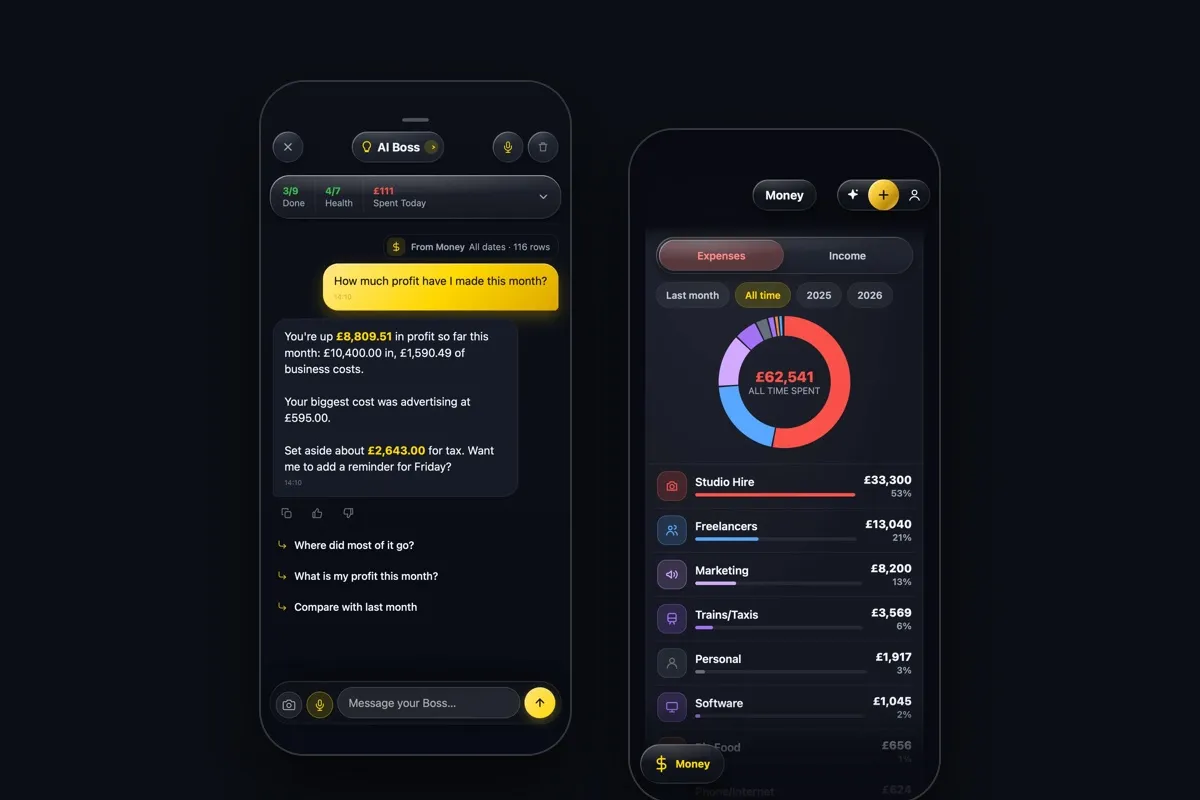
You need your money visible every day, in the same place as your tasks and your energy levels, so you can make joined-up decisions. This is exactly what knowing your financial position at a glance allows you to do. When your spending, your runway and your task list all live in one place, you stop making decisions in isolation. You stop booking an expensive co-working day when your runway is tighter than you thought. You stop ignoring your pipeline because your tasks are buried in a separate app you rarely open.
The practical move here is simple: every morning, before you do anything else, look at three things. What is my current financial position? What are my open tasks and deadlines? How is my energy today? Those three inputs determine your entire day. If you are running them through three separate apps, you are creating unnecessary friction and losing the connective tissue between them.
Step Two: Let Something Tell You What to Do Next
This sounds almost too simple, but it is the most powerful shift you can make during a gap period: stop deciding what to do next from scratch every morning, and start letting a system decide for you.
The freelancer who knows their single best next action at 8am will always outperform the one who spends until 10am figuring it out.
The concept of one clear next action is not new. But most productivity systems make you do the prioritisation yourself, which puts you right back in the decision fatigue loop. What actually works is having something that reads your tasks, your deadlines and your current energy, and surfaces the one thing you should do right now. Not a list of ten things. One thing.
During an income gap, that one thing is usually one of the following:
- Send a specific pitch or follow-up to a warm lead
- Complete a piece of speculative work that builds your pipeline
- Handle a piece of financial admin before it becomes urgent
- Rest or recover properly so you are sharp for client calls
The order matters. And the order changes depending on your deadlines, your energy and your financial runway. A good system accounts for all of that. A static to-do list does not.
Step Three: Log Every Penny Without Making It a Chore
During a gap, your spending habits change. You are at home more. You are stressed. You are possibly treating yourself to compensate for the anxiety of not earning. None of this is a moral failing. It is human. But it does mean your outgoings need closer attention precisely when you are least inclined to give it.
The reason most people fail at expense tracking during quiet periods is friction. Opening a spreadsheet, finding the receipt, categorising the spend, doing it again tomorrow. It is boring and it feels punitive. The moment it feels like punishment, you stop doing it.
Voice logging removes that friction almost entirely. Being able to say out loud what you just spent, have it logged instantly and see it reflected in your running total, takes the discipline requirement down to almost nothing. You just narrate your day. The record keeps itself. And at the end of the week, you have an honest picture of where your money actually went, not where you think it went.
For anyone on the Business plan, that same logging feeds directly into HMRC-ready bookkeeping, which means your gap period admin becomes your tax prep at the same time. That is one less thing to dread when the next project lands and you suddenly have no time for anything else.
Step Four: Reschedule Honestly, Not Optimistically
Here is a pattern almost every freelancer will recognise. You set yourself an ambitious plan for the gap. You will pitch twenty clients, rewrite your website, sort your accounts and start that course you bought six months ago. By day three, you are already behind. By day seven, the plan has quietly collapsed and you are improvising.
The problem is not ambition. The problem is that most planning tools let you lie to yourself. They let you stack tasks into a day that could not physically contain them, and then they just sit there silently judging you when you do not complete them.
Honest rescheduling is different. It means that when something does not get done, the system does not nag you or make you feel guilty. It looks at what is left, what your deadlines actually are, and it moves things to where they can realistically happen. It treats you like an adult with a finite amount of time and energy, not a productivity machine that just needs more willpower.
During an income gap, this matters enormously. Your energy is not consistent. Some days you are sharp and motivated. Others you are anxious and distracted. A system that reschedules honestly around your actual capacity will always outperform a rigid plan that assumes you are a robot.
Step Five: Build the Pipeline Before You Need It
The best time to find your next project is before the current one ends. The second best time is the first day of your gap, not the last. Most freelancers do the opposite. They decompress for a week, then start to feel the financial pressure, then panic-pitch from a position of desperation. Clients can feel desperation. It does not help your rates.
Your income gap survival system needs a pipeline component built in from day one. That means your task list during the gap always includes at least one outreach or follow-up action per day, even on low-energy days. Especially on low-energy days, because a short, warm message to a previous client takes ten minutes and can change your entire month.
The key is that pipeline tasks need to sit alongside your financial picture, not in a separate app you only open when you remember. When you can see your runway shrinking and your pipeline tasks in the same view, you make better decisions about urgency. You do not need willpower to prioritise outreach when the numbers are right there telling you why it matters.
You can read more about building better daily systems on the BossMode blog, where we cover practical approaches to freelance focus, money and execution.
Why One App Beats Five Apps Every Time
Let us be direct about something. The reason most freelancers struggle during income gaps is not a lack of good advice. There is no shortage of articles telling you to track your spending, build a pipeline, prioritise your tasks and look after your health. You know all of this. The problem is execution, and execution breaks down when your tools are fragmented.
When your to-do app is one thing, your budgeting app is another, your habit tracker is a third and your AI assistant is a fourth, you are managing four separate systems, four separate logins and four separate mental models. That overhead is exhausting on a normal week. During a high-stress income gap, it is the first thing that collapses.
Consolidation is not laziness. It is strategy. Keeping your money, your tasks and your health in one place, with one system telling you the single best next action, is what makes consistent execution possible without burning yourself out in the process.
BossMode was built specifically for this. Created by Swain Joshua and developed by SWAINUK LIMITED, it works as your AI Boss: it reads your tasks, your deadlines and your energy, and it tells you what to do next. You log spending by voice. You see your money and your tasks on one screen. When things slip, it reschedules honestly instead of nagging you. And on the Business plan, it handles HMRC-ready bookkeeping so your gap period admin is not wasted time. It is the app that replaces the mess of juggling five tools and still feeling behind.
Get BossMode on iPhone and Close the Gap for Good
If you are reading this between projects, or you can already see a gap coming at the end of your current one, now is the right time to put a proper system in place. Not next month. Not when things calm down. Now, while you have the space to set it up properly.
BossMode is available on iPhone. Get it at bossmode.uk, connect your tasks and your finances, and let your AI Boss tell you the single best thing to do today. Stop losing weeks to indecision and quiet financial leakage. The gap does not have to be a crisis. With the right system, it becomes the period where you get ahead.
Search for BossMode on the App Store and start running your freelance life like a business that actually knows what it is doing.
Frequently asked questions
What should I do on the very first day of a freelance income gap?
On day one, do three things before anything else. Check your exact financial runway so you know how many weeks you can operate without new income. Write down every open lead or warm contact you have not followed up with. Then set one outreach task for that same day. Starting with clarity on your numbers and one concrete action prevents the drift that turns a short gap into a long one.
How do I stay productive between freelance projects without burning out?
Productivity during a gap depends on matching your tasks to your energy, not forcing a rigid schedule. On high-energy days, focus on pitching, creating and anything that requires sharp thinking. On low-energy days, handle admin, voice-log your expenses and do light pipeline maintenance. The key is having a system that adjusts to your actual state rather than assuming you perform the same every day.
How much of a financial buffer should a freelancer keep for income gaps?
A common guideline is three months of essential living costs as a minimum buffer. However, the more important habit is knowing your exact monthly baseline spend so you can calculate your real runway at any point. Many freelancers overestimate their buffer because they are not tracking small daily expenses accurately. Voice logging your spending in real time gives you a much more honest picture than a rough mental estimate.
How does BossMode help freelancers during quiet periods specifically?
BossMode acts as your AI Boss during income gaps by surfacing the single best next action based on your tasks, deadlines and energy. It keeps your money and tasks visible on one screen so you are not switching between apps. You can log spending by voice to track outgoings without friction. And when plans slip, it reschedules honestly rather than nagging you, which means your system stays usable even on difficult days.
Is the HMRC bookkeeping feature in BossMode useful during freelance gaps?
Yes, particularly because gap periods often involve a mix of business expenses, subscriptions and equipment purchases that are easy to forget by the time tax season arrives. The Business plan HMRC-ready bookkeeping means that logging your expenses during the gap, which you should be doing anyway to manage your runway, simultaneously builds your tax records. You are not doing double work. The admin you need for survival becomes the admin you need for compliance.
BossMode is your AI Boss for iPhone. It plans your day, tracks your money and keeps you moving.
Get BossMode