
Expenses
Business or personal? How to split mixed payments on your bank statement
Phone bills, broadband, a car you also drive at weekends. How UK sole traders and directors can split mixed payments fairly, in a way HMRC accepts.
Plenty of payments on a self-employed person's statement are neither fully business nor fully personal. The phone you use for clients and family. Home broadband. A car that does client visits on Tuesday and the supermarket on Saturday. Getting these wrong is one of the easiest ways to overclaim or underclaim, and both cost you. Here is how to split them in a way HMRC would accept.
The rule: wholly and exclusively
HMRC allows expenses that are incurred "wholly and exclusively" for the business. For a payment that is partly personal, that means you can claim the business part, as long as you can separate it in a reasonable way. The GOV.UK guide to self-employed expenses says the same: if you use something for both business and personal reasons, you can only claim the business share.
Two consequences:
- You must be able to explain the split. "About half" is weak. "Half, based on the itemised bill for March" is fine.
- Some things cannot be split at all. Everyday clothes, food and personal grooming are personal even if they help you look professional.
Common mixed payments and fair ways to split them
| Payment | A reasonable way to split |
|---|---|
| Mobile phone contract | Business share of calls and data from a typical month's bill |
| Home broadband | Hours online for work against total household use |
| Car costs (sole trader) | Business miles as a share of total miles, or use the simplified mileage rate instead |
| Home office (sole trader) | HMRC flat rate by hours worked at home, or a share of household bills |
| Software or subscriptions used at home | Business use share, often 100% if it is a work tool |
For cars and vans, the simplest route for most sole traders is HMRC's simplified mileage rate: 45p a mile for the first 10,000 business miles and 25p after that, instead of claiming running costs. The mileage tracking guide goes through that in detail.
Working from home: the flat rate
Sole traders who work from home for 25 hours or more a month can use HMRC's flat rate instead of calculating a share of bills:
- 25 to 50 hours a month: £10
- 51 to 100 hours a month: £18
- 101 hours or more a month: £26
That covers heating, electricity and the like. Phone and internet are still claimed separately, at their business share. Full details are on the working from home simplified expenses page.
If you run a limited company, the company cannot simply pay your home bills as its costs. The usual routes are a fixed weekly allowance or a formal arrangement, so ask an accountant before you set one up.
How to split it on the statement
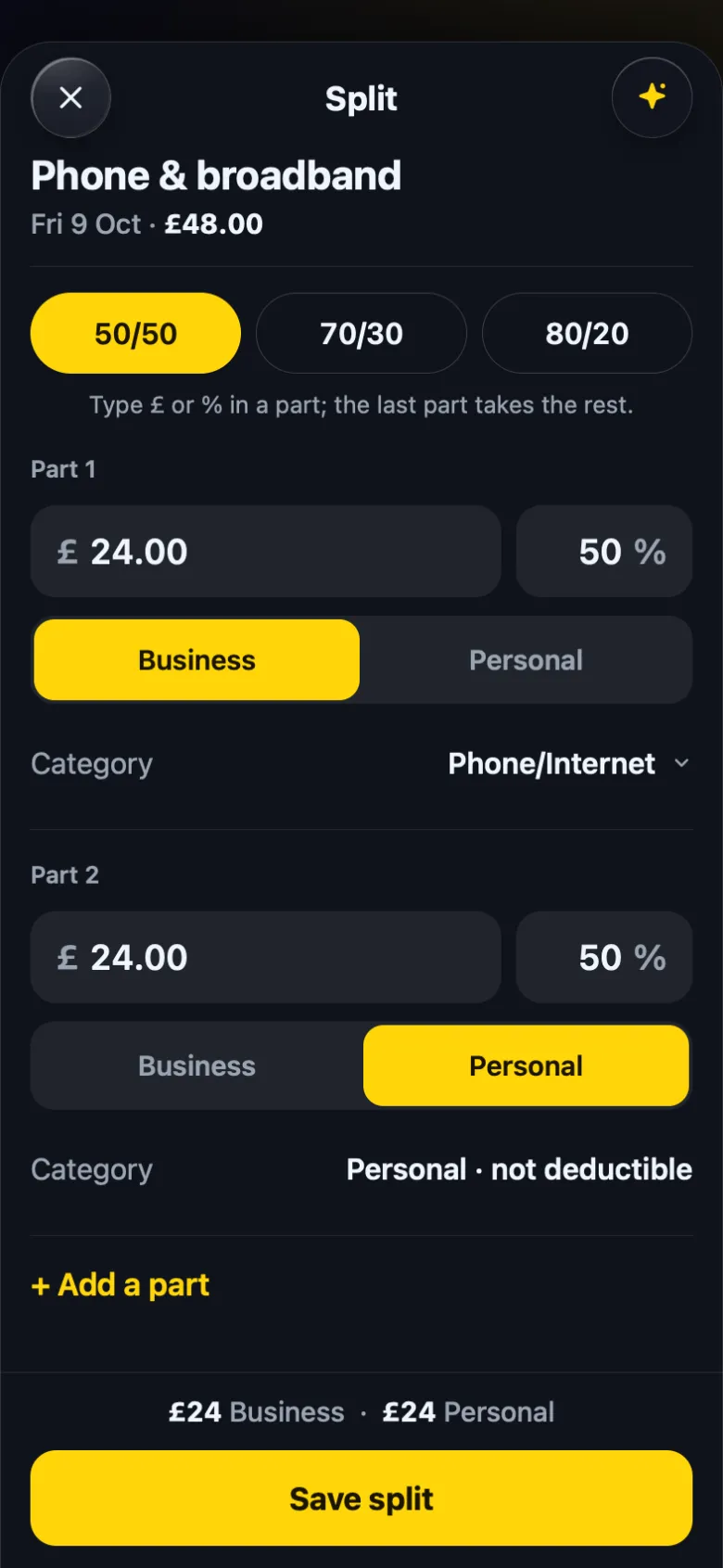
The payment comes out of your account as one line, say £48 for phone and broadband. Do not change the amount or claim it twice. Split the one line into parts that add back up to the original:
- Part 1, business: £24, category Phone and internet.
- Part 2, personal: £24, Personal (not deductible).
In BossMode you open the line and choose Split. Presets for 50/50, 70/30 and 80/20 cover most cases, or type an amount or a percentage into a part and the last part takes the rest. Each part gets its own Business or Personal switch and its own category, so only the business share reaches your expenses.
Mistakes that cause trouble
Most problems with mixed payments come from one of these:
- Claiming the whole thing. Putting the full phone bill or the whole car insurance through the business because "I mostly use it for work". If HMRC checks, you need to show it, and a 100% claim on a family phone is hard to defend.
- Claiming twice. Using the simplified mileage rate and also claiming fuel and servicing for the same car. You choose one method per vehicle.
- Splitting the wrong things. A weekly food shop is not 20% business because you had a coffee with a client. Leave personal spending personal.
- Changing the line itself. Editing the £48 to £24 makes your statement stop adding up. Keep the full amount and split it into parts.
Be consistent month to month
A split you can defend is one you apply every time. If the phone is 50% business in January, it should not be 80% in March unless something changed. Two habits help:
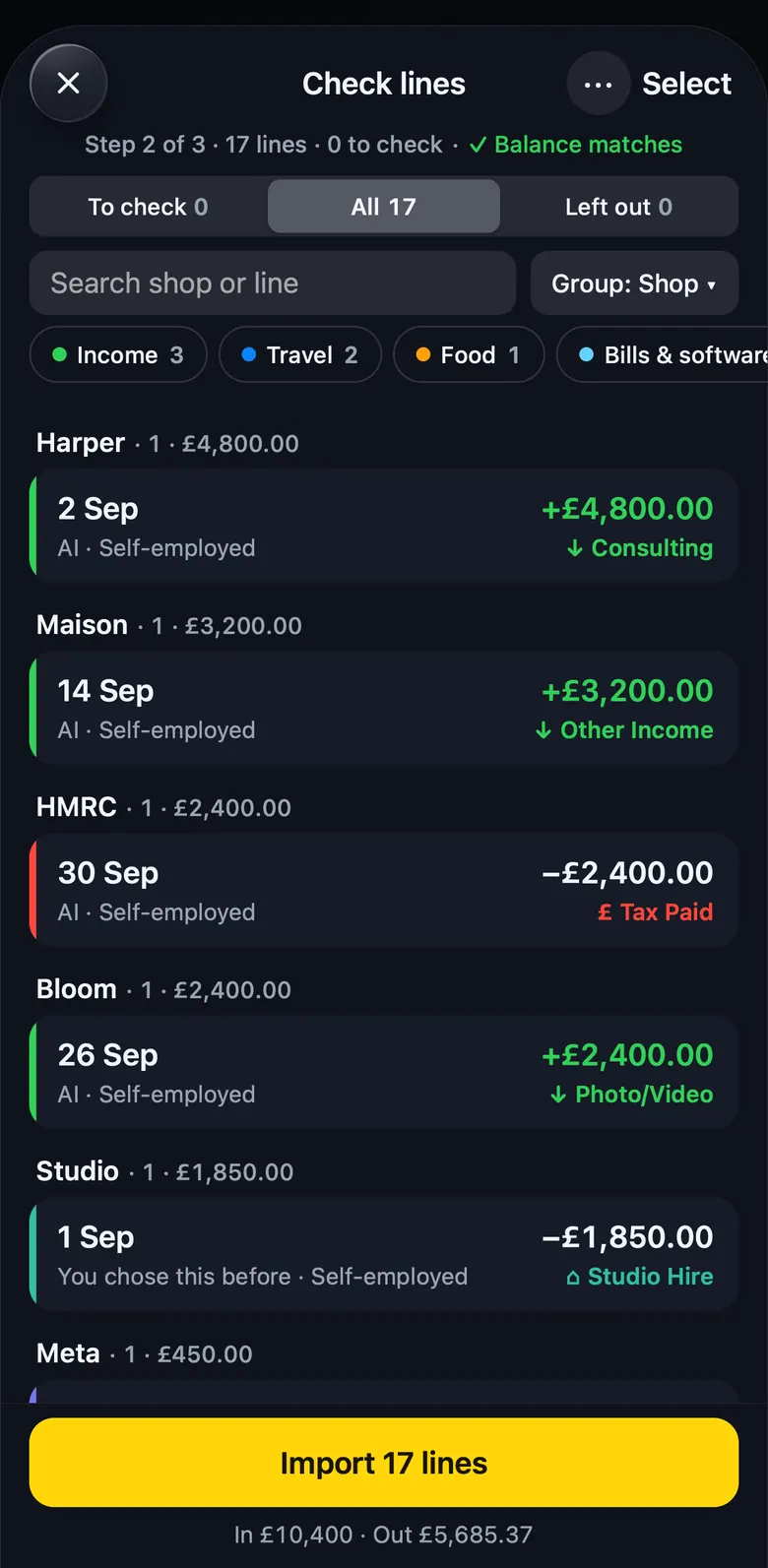
- Decide once per supplier. When you sort a statement by shop, the same supplier gets the same treatment every month. See how to sort a bank statement into HMRC categories.
- Write down the method. A one-line note, such as "phone 50% from itemised bill, March 2026", is enough to show how you got there.
What it does to your return
Only the business parts count towards your allowable expenses. On a sole trader's return they land in the matching box, so the business half of the phone bill joins your other office costs in box 23. The personal parts never appear. The box-by-box picture is in Self Assessment for sole traders: what goes in each box.
Done properly, splitting is not about squeezing more out of HMRC. It is about a profit figure you trust, because it contains everything the business spent and nothing it did not.
Where BossMode helps
BossMode keeps the split attached to the original payment, so your statement still adds up to the penny and your expense total stays honest. You can attach the receipt to the entry, and change a category once for a shop so the next statement arrives already sorted. The tax figures are a guide built from your own records, not tax advice.
Questions people ask
What percentage of my phone bill can I claim?
The share that is genuinely for business. If roughly half your calls and data are for work, 50% is reasonable. Pick a method you could explain, such as a typical month's itemised bill, and use it every month.
Can I claim part of my rent if I work from home?
As a sole trader you can either use HMRC's flat rate, based on the hours you work at home each month, or work out a fair share of your actual household costs. Directors of a limited company follow different rules, so check before claiming.
Should I split every supermarket shop?
No. Food and household shopping is personal. Only split a payment when part of it was really bought for the business, such as printer ink in a bigger shop.
Do I need receipts for split payments?
Keep the evidence for the whole payment and a note of how you worked out the business share. Attaching the receipt to the entry means it is there if HMRC asks.
BossMode is coming to the App Store
Import a statement, check it adds up, and see your tax return figures box by box on your iPhone. Leave your email and we will tell you the day it launches.
Get notified at launch Every plan will start with a 14-day free trial through Apple. See plans.