
Bookkeeping
How to sort a bank statement into HMRC expense categories
How UK sole traders and Ltd directors can turn a year of bank statement lines into HMRC categories, check it adds up and keep personal spending out.
Most self-employed people do not have a bookkeeping problem. They have a bank statement problem: hundreds of lines with names like ADOBE *CREATIVE CLOUD and AMZNMKTPLACE, and no clear idea which ones HMRC cares about. This guide is the method I use, step by step, whether you are a sole trader filling in a Self Assessment or a director getting figures ready for a company return.
Start with the right statements
Download every statement for the period you are reporting. For a sole trader that is the tax year, 6 April to 5 April. For a limited company it is the company's accounting period, which may not line up with the tax year at all.
Get them as PDF or CSV from your banking app rather than screenshots. A CSV is the cleanest because every line is already data. Include every account and card the business uses, including the credit card you sometimes put software on. Missing one card is the most common reason an expense total comes out low.
Check the statement adds up before you sort anything
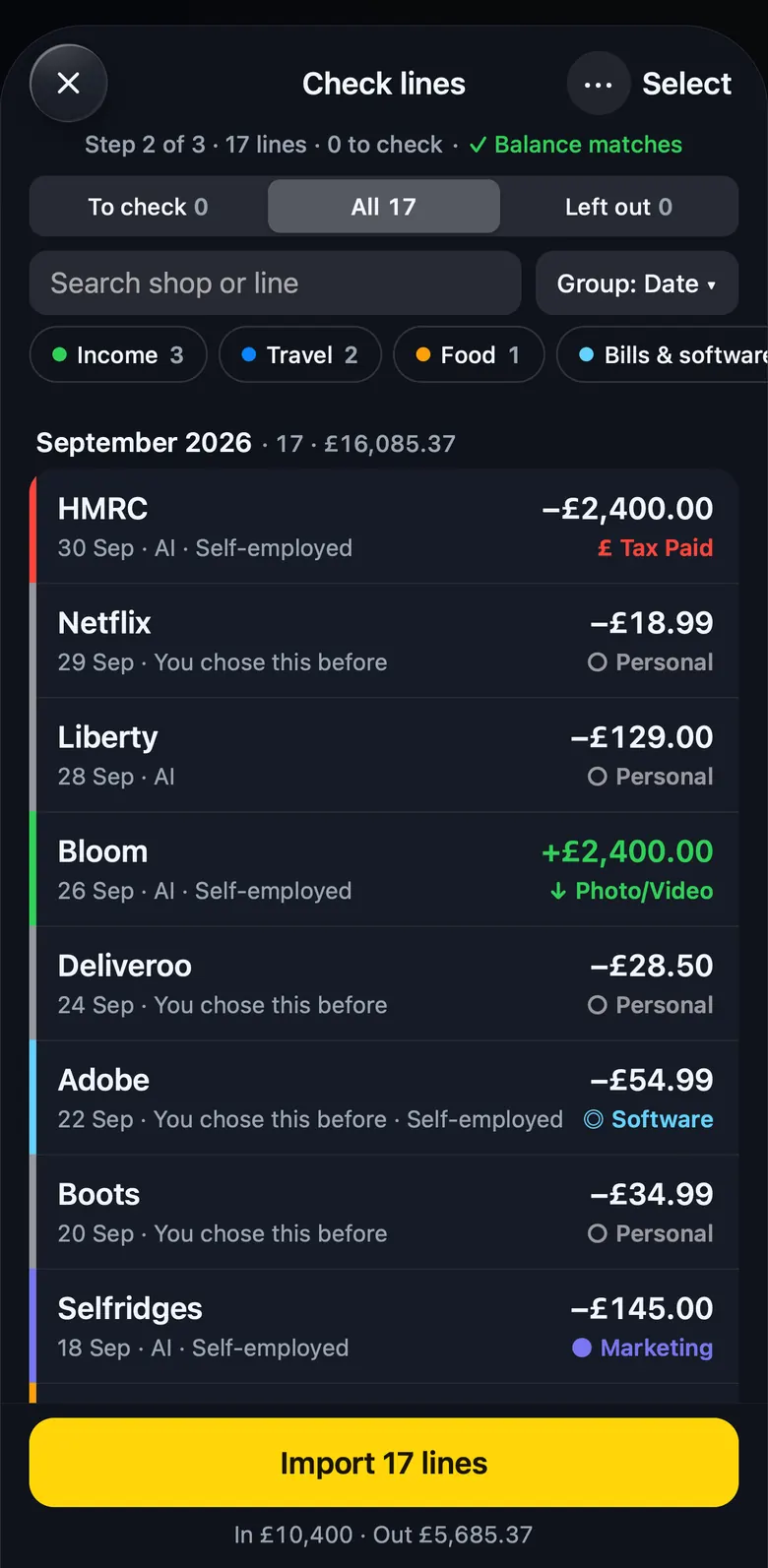
This step is skipped by almost everyone and it is the one that saves you later. Take the opening balance, add every line, and you should land exactly on the closing balance. If you do not, a line is missing, doubled or has the wrong sign, and every total you build on top of it will be wrong.
When you import a statement into BossMode, it does this check for you. It reads date, description, amount and the running balance, repairs signs from the balance, and tells you if the lines add up to the penny. If they do not, it points at the line where the balance breaks so you can fix that one line instead of hunting.
Sort by shop, not line by line
A year of statements might be 1,500 lines, but they usually come from fewer than 100 places. Your studio rent, Adobe, the same taxi firm, the same supermarket. Sorting each line one at a time is slow and inconsistent: the same shop ends up in three categories.
Group the lines by shop instead and decide once per supplier. In BossMode the review screen has a By shop view, so setting one supplier sets every line from it. It also remembers that choice, so next month's statement arrives already sorted for every shop you have seen before.
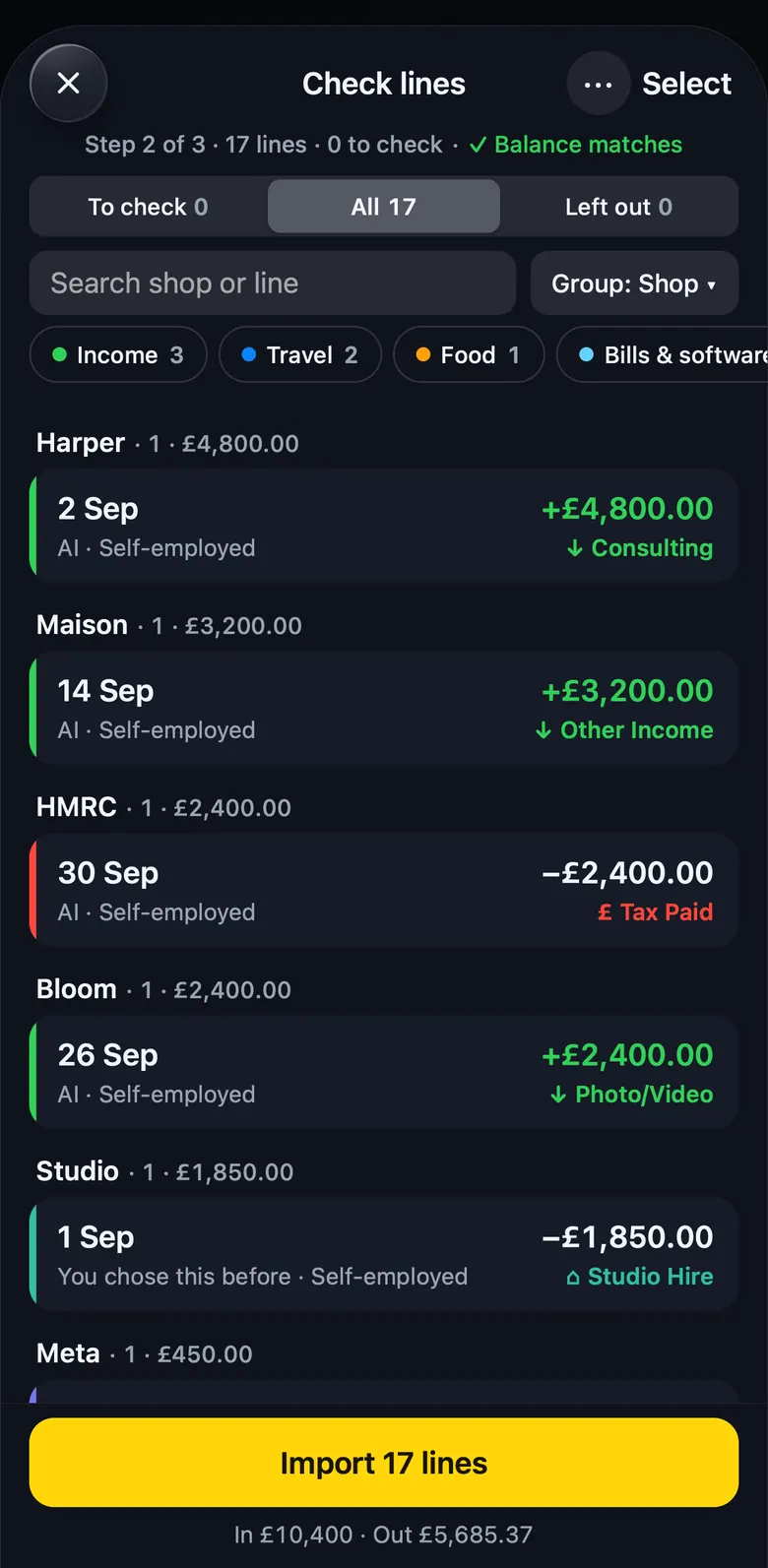
The order BossMode sorts in matters for accuracy. Your own past corrections win first, then your history with that shop, then AI for shops it has never seen, then simple rules. Your choices always beat a guess.
The HMRC categories that cover most sole traders
The full self-employment pages of the return (the SA103F) group allowable expenses into boxes. These are the ones most freelancers and small businesses actually use:
| What you spent on | SA103F box |
|---|---|
| Stock or materials you resell or use up | Box 17 |
| Car, van and travel (trains, taxis, flights for work) | Box 20 |
| Rent, rates, power and insurance | Box 21 |
| Phone, internet, stationery and other office costs | Box 23 |
| Advertising | Box 24 |
| Bank and card charges | Box 26 |
| Accountancy and legal fees | Box 28 |
| Other allowable business expenses | Box 30 |
Income goes in box 15 (turnover) and box 16 (any other business income). Software subscriptions usually sit with office costs or other expenses, depending on what you use them for. HMRC's own guide to expenses if you're self-employed lists what is allowable under each heading.
A limited company works with different lines: turnover, cost of sales, staff costs, administrative expenses and so on. I cover those in limited company bookkeeping from bank statement to CT600 figures.
Things that are not business expenses
Most mistakes in a home-made return are not missing expenses. They are personal spending that slipped in. Be strict with these:
- Groceries, clothes and gym membership. Personal, even if you wear the clothes to meetings. Uniforms and protective kit are the exception.
- Client entertaining. Taking a client to lunch is not an allowable expense for tax, even though it feels like work.
- Commuting. Travel to a regular place of work is personal. Travel to a client's site or a temporary job is business.
- Tax payments. Paying HMRC is not an expense. Mark it as tax paid so it stays out of your costs.
- Transfers between your own accounts. Money moving from your business account to your savings is neither income nor cost.
In BossMode these go to Personal (not deductible) or Leave out, and they never reach the expense total on your return.
If you would have bought it anyway without the business, it is almost certainly personal.
Split the payments that are both
Some lines are honestly mixed: a phone contract you use for clients and family, broadband at home, a car you also drive at weekends. HMRC lets you claim the business share as long as you can explain how you worked it out. Split the payment rather than guessing the whole thing one way.
There is a full walk-through in business or personal: how to split mixed payments.
Check the totals, then use them
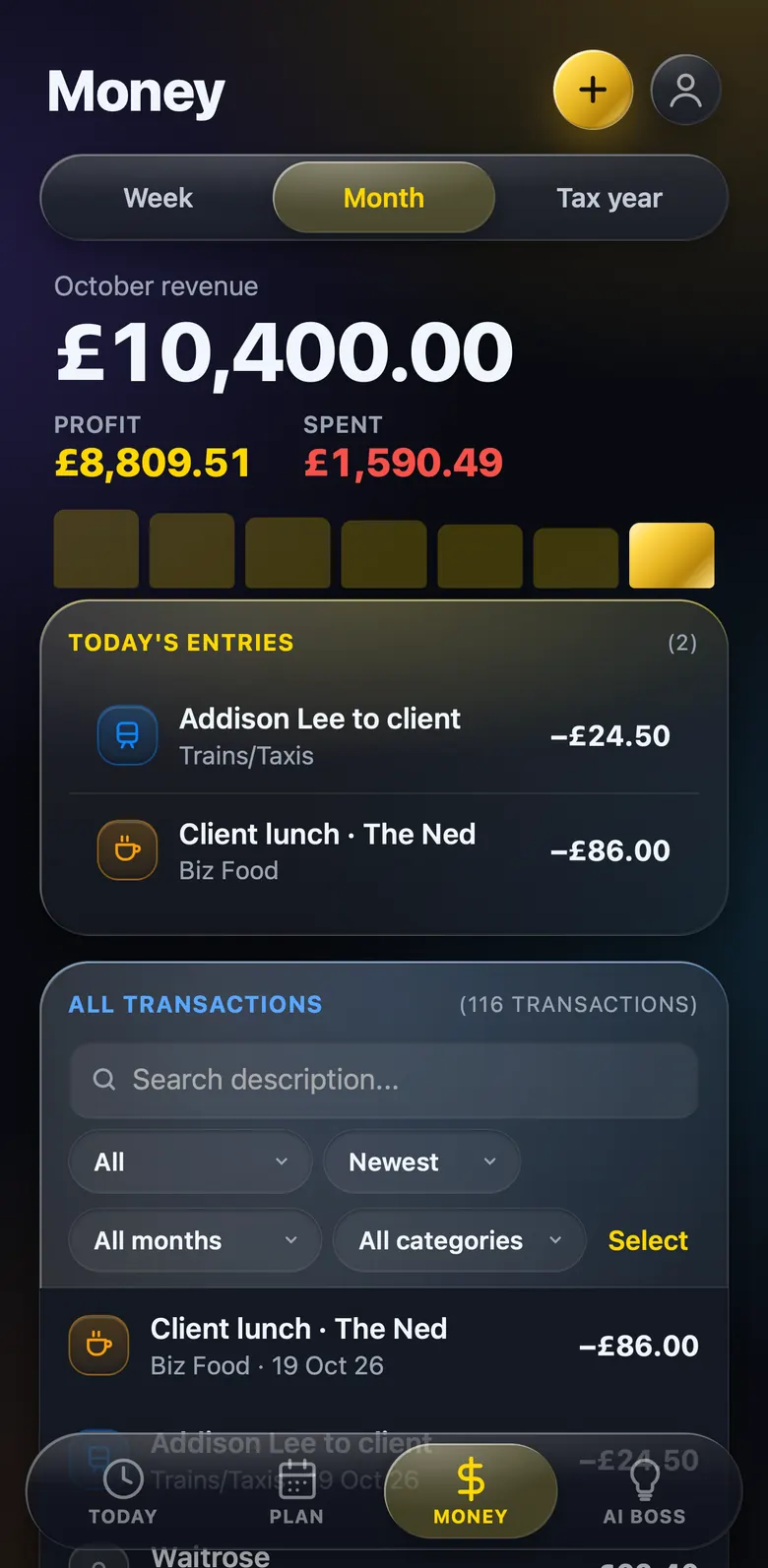
When every line has a home, look at the totals by category for the year. Anything that looks odd, such as travel higher than rent, or zero bank charges, is worth one more look. The category breakdown in BossMode's Money tab shows where every pound went for the week, month or tax year.
From there, the figures feed straight into your return. For a sole trader that is turnover, other income and the expense boxes, explained box by box in Self Assessment for sole traders: what goes in each box. If you want the receipts side covered too, read self-employed expenses people forget to claim.
Where BossMode fits
BossMode does the slow parts of this method on your iPhone: it imports the statement, checks it adds up, sorts by shop and remembers your choices, and keeps business and personal apart. The tax return guide then lays out your figures box by box. You still file on GOV.UK yourself, and it is a guide rather than tax advice, so speak to an accountant if your situation is unusual.
Questions people ask
Can I do my Self Assessment from bank statements alone?
For most sole traders the bank statement is the backbone of the records, but HMRC expects you to keep the evidence behind the figures too, such as invoices and receipts. Sort the statement first, then attach receipts to the lines that need them.
What if a payment is partly business and partly personal?
Split it. Claim only the business share, for example the business part of a phone contract, and mark the rest as personal so it never reaches your expense total.
Do I need a separate business bank account as a sole trader?
It is not a legal requirement for sole traders, but it makes sorting far easier. A limited company must keep its money separate from yours, because the company is a separate legal person.
Does BossMode need my online banking login?
No. You import a PDF or CSV statement you have downloaded, or a photo of a paper one. Starling customers can connect with a read-only token that cannot move money.
BossMode is coming to the App Store
Import a statement, check it adds up, and see your tax return figures box by box on your iPhone. Leave your email and we will tell you the day it launches.
Get notified at launch Every plan will start with a 14-day free trial through Apple. See plans.