
Limited company
Limited company bookkeeping: from bank statement to CT600 figures
How a one-person limited company can sort bank statements into company lines, see profit and an estimated Corporation Tax bill, and get CT600 figures ready.
Running a one-person limited company means two sets of paperwork: the company's, and your own. The company needs annual accounts at Companies House and a Company Tax Return (CT600) at HMRC. Both start from the same place as a sole trader's books, the bank statement, but the lines they ask for are different. This guide covers the company side.
The company is not you
The first rule of limited company bookkeeping: the company's money is the company's. It has its own bank account, its own income and its own costs, and every payment out of that account is either a company cost, a payment to you (salary, dividends, expenses repaid), or a loan to you.
That last one catches people. Pay for your shopping from the company card and it does not become a company expense. It becomes money you owe the company, recorded on your director's loan account. Leave it unpaid for more than 9 months after the year end and the company pays an extra temporary tax on it.
So when you sort a company statement, every personal line needs to be marked as personal, not quietly put under "sundries".
The lines a company return needs
A sole trader sorts costs into SA103F boxes. A company sorts them into profit and loss lines, which then feed the accounts and the CT600:
- Turnover: what the company invoiced and was paid for its work.
- Other income: income outside the main trade, such as bank interest.
- Cost of sales: direct costs of doing the work, such as subcontractors or materials.
- Staff costs: salaries, including the director's salary, and employer costs.
- Administrative expenses: rent, software, phone, insurance, travel, accountancy and the rest of the overheads.
- Interest payable: interest on business loans.
- Disallowable expenses: real company spending that the tax rules do not allow, such as client entertaining. It stays in the accounts but is added back for tax.
Equipment works differently. A laptop or a camera is a fixed asset, not an expense in the profit and loss account, but the Annual Investment Allowance usually lets the company deduct the full cost from taxable profit in the year it buys it.
From profit before tax to Corporation Tax
Once the lines are sorted, the sums are simple:
- Turnover plus other income, minus all costs, gives profit before tax.
- Add back the disallowable expenses and take off capital allowances to get taxable profit.
- Apply the Corporation Tax rates: 19% on profits up to £50,000, 25% over £250,000, and marginal relief in between.
BossMode does exactly these steps on the entries tagged to your Ltd and shows each line, so you can see where the number came from rather than trusting a total.
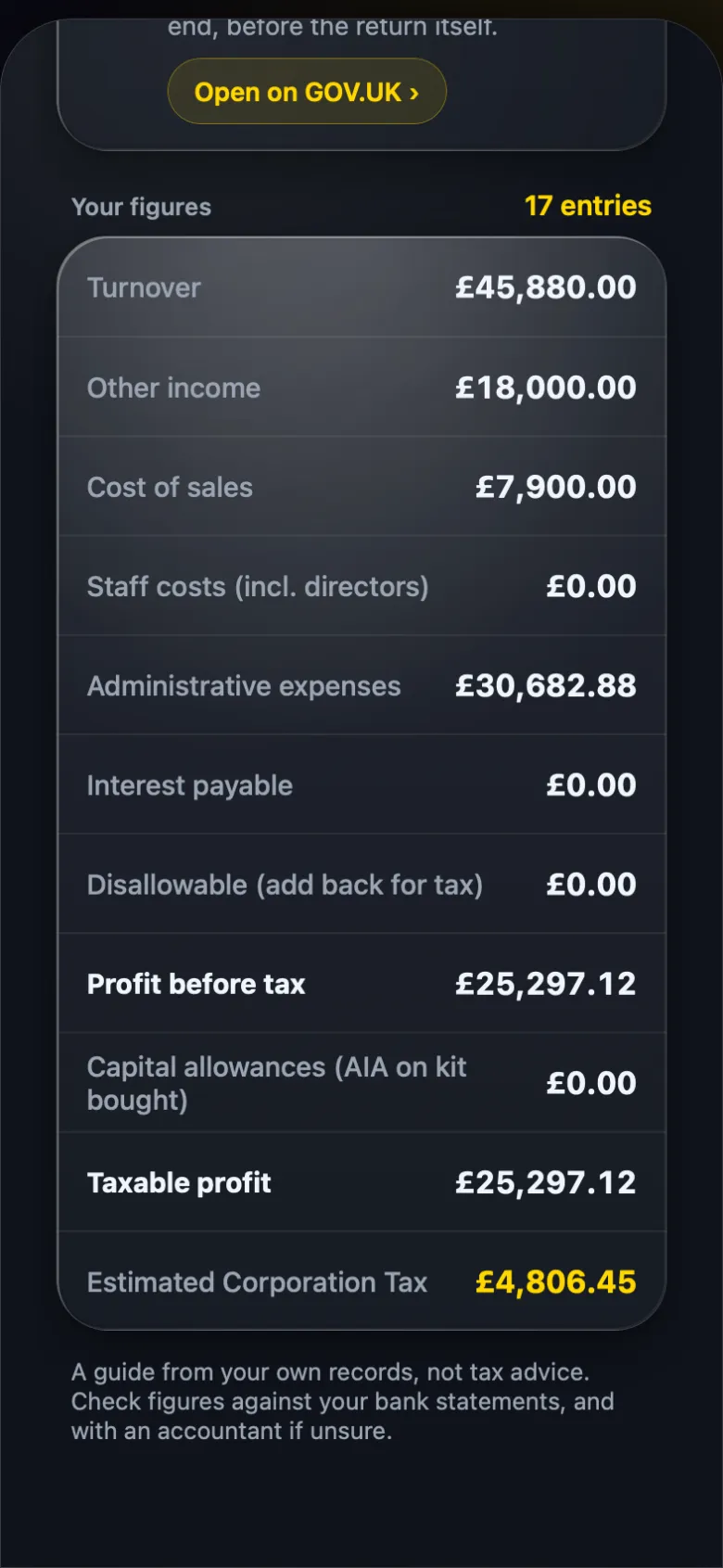
In that example, taxable profit is £25,297.12, under £50,000, so the estimate is 19%: £4,806.45. Knowing that number months before the deadline is the whole point. Set it aside in a separate account and January stops being a shock.
The three company deadlines
For a company with a year ending 31 March 2026, the dates fall like this:
| What | When | Rule |
|---|---|---|
| Pay Corporation Tax | 1 January 2027 | 9 months and 1 day after the year end |
| Accounts to Companies House | 31 December 2026 | 9 months after the year end |
| CT600 to HMRC | 31 March 2027 | 12 months after the year end |
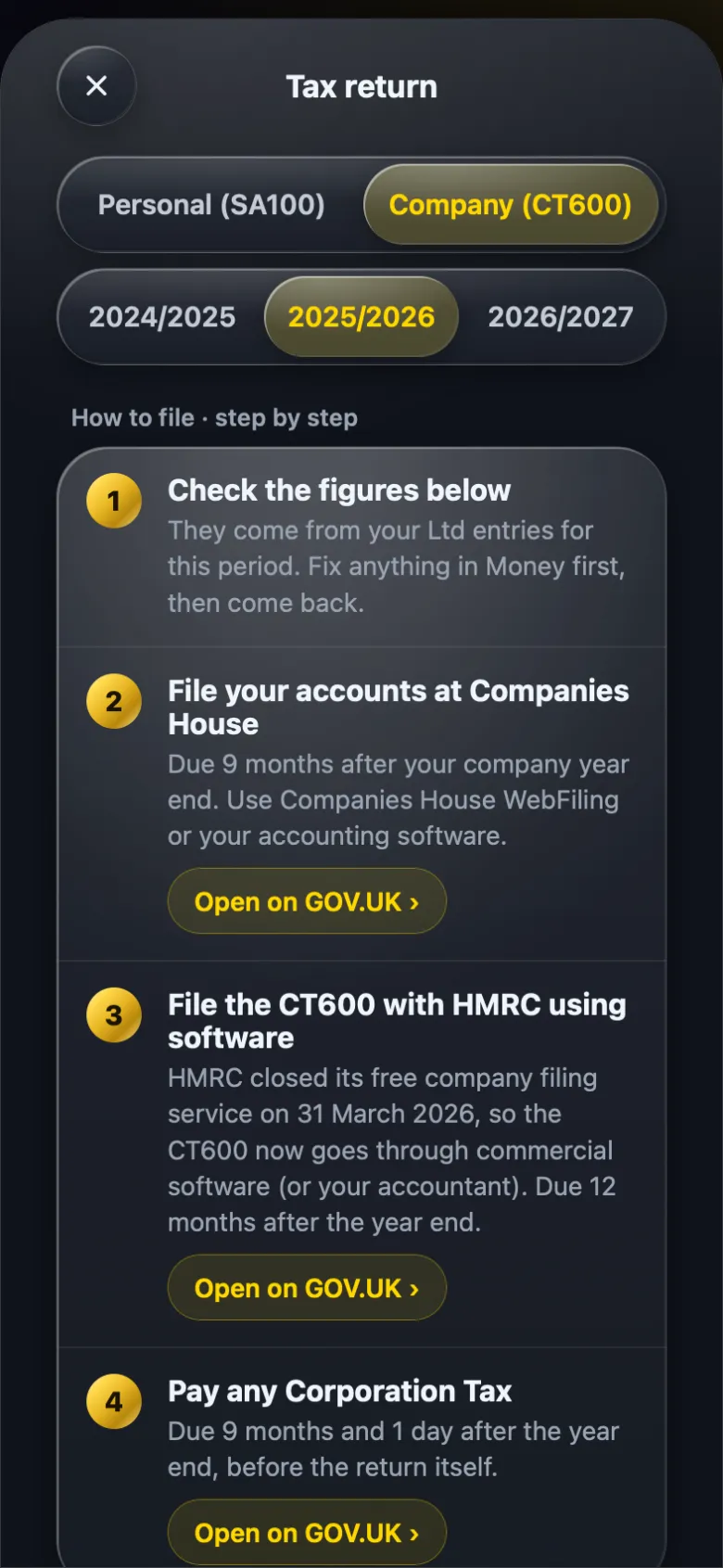
Notice that the tax is due before the return. Pay on time even if the CT600 is not ready. Since HMRC closed its free company filing service on 31 March 2026, the CT600 has to go through commercial software or an accountant. Accounts go to Companies House separately; see file your company's annual accounts.
Your own return as a director
Directors usually file a personal Self Assessment too. The salary the company paid you and any dividends you took go on your SA100, not on the company's return. If you are also a sole trader on the side, that income goes on the self-employment pages of the same return; Self Assessment for sole traders: what goes in each box covers that part.
In BossMode each entry is tagged Ltd or self-employed, so the company's money and your sole trader money never mix, and the personal guide picks up your company salary and dividends.
A routine that keeps the company books current
You do not need to sit down with a year of statements in December. Once a month is enough:
- Import the company statement and check it adds up to the penny.
- Sort by shop; most suppliers will already be remembered from last month.
- Mark anything personal as personal straight away, so the director's loan figure stays honest.
- Split mixed payments, such as a phone contract, as explained in business or personal: how to split mixed payments.
- Glance at the estimated Corporation Tax and move that amount aside.
The full sorting method is in how to sort a bank statement into HMRC categories.
Where BossMode stops
BossMode gets the bookkeeping and the figures ready on your iPhone, with the CT600 lines, the estimate and the deadlines in one place. It does not file accounts or the CT600 for you, and it is a guide, not tax advice. Many directors use it to keep the books tidy all year, then hand clean figures to their accountant or filing software.
Questions people ask
When is the CT600 due?
The Company Tax Return is due 12 months after the end of the accounting period it covers. The Corporation Tax itself is usually due earlier, 9 months and 1 day after the period ends.
Can I still file a CT600 on HMRC's website?
No. HMRC closed its free company filing service on 31 March 2026, so the CT600 now goes through commercial software or an accountant.
What happens if I pay for personal things from the company account?
That money is not a company expense. It is usually treated as a loan to you through your director's loan account, which has its own tax rules if it is not repaid in time.
Is the Corporation Tax figure in BossMode exact?
It is an estimate from your own records using the main rates and marginal relief. Your final figure can differ, for example because of other adjustments or reliefs, which is why it is a guide and not tax advice.
BossMode is coming to the App Store
Import a statement, check it adds up, and see your tax return figures box by box on your iPhone. Leave your email and we will tell you the day it launches.
Get notified at launch Every plan will start with a 14-day free trial through Apple. See plans.